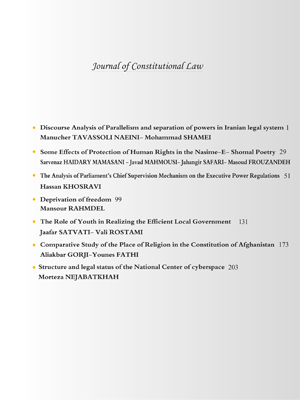
Discourse Analysis of Parallelism and separation of powers in Iranian legal system
Document Type : Original Article
Authors
1
Assistant Professor University of Isfahan
2
Assistant Professor, University of Isfahan University of Medical Sciences, Islamic Azad University, Kharasgan Branch, Isfahan
Abstract
Parallelism or formation of legal institutions with similar structure and tasks in legislative , judicial and administrative organizations and institutions has become the prevailing paradigm in Iranian legal system. This contradicts with the principle of separation of powers that defined specified duties for three powers in the framework of good governance. Different legislative bodies ,that pass or supervise the contents of Iranian constitution, call into question the main duty of the parliament. Moreover, the establishment of dispute resolution councils ,special tribunals and the nature of some decisions in judicial system challenge the independence of judicial system in administrative section. In the same vein, in the executive section, parallelism exists as a result of the numerous ministries as well as the security- centered viewpoint that was formed in the light of broad phrases of the legislator. Parallelism has changed the principle of separation of powers to an approach that characterized with mixed and repeated division of tasks. The solution of the crisis is the modification of the constitution based on the principle of separation of powers.
Keywords